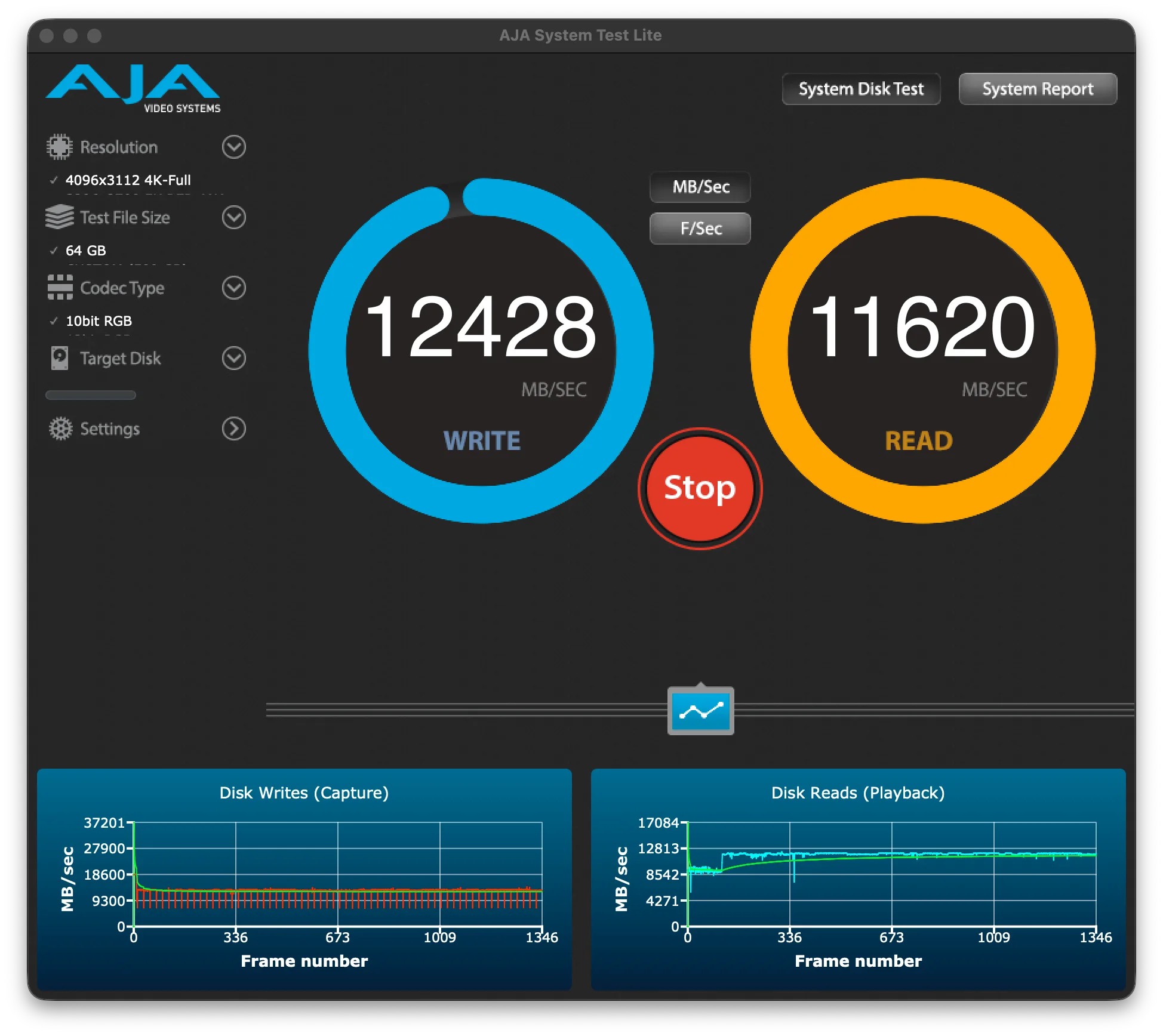
The internal SSD in the M5 Pro Mac mini is very fast, and it stays that way. It posted about 11.2 GB/s read and 11.7 GB/s write, then held above 11.6 GB/s
both ways after more than 15 minutes of nonstop testing.
First impressions
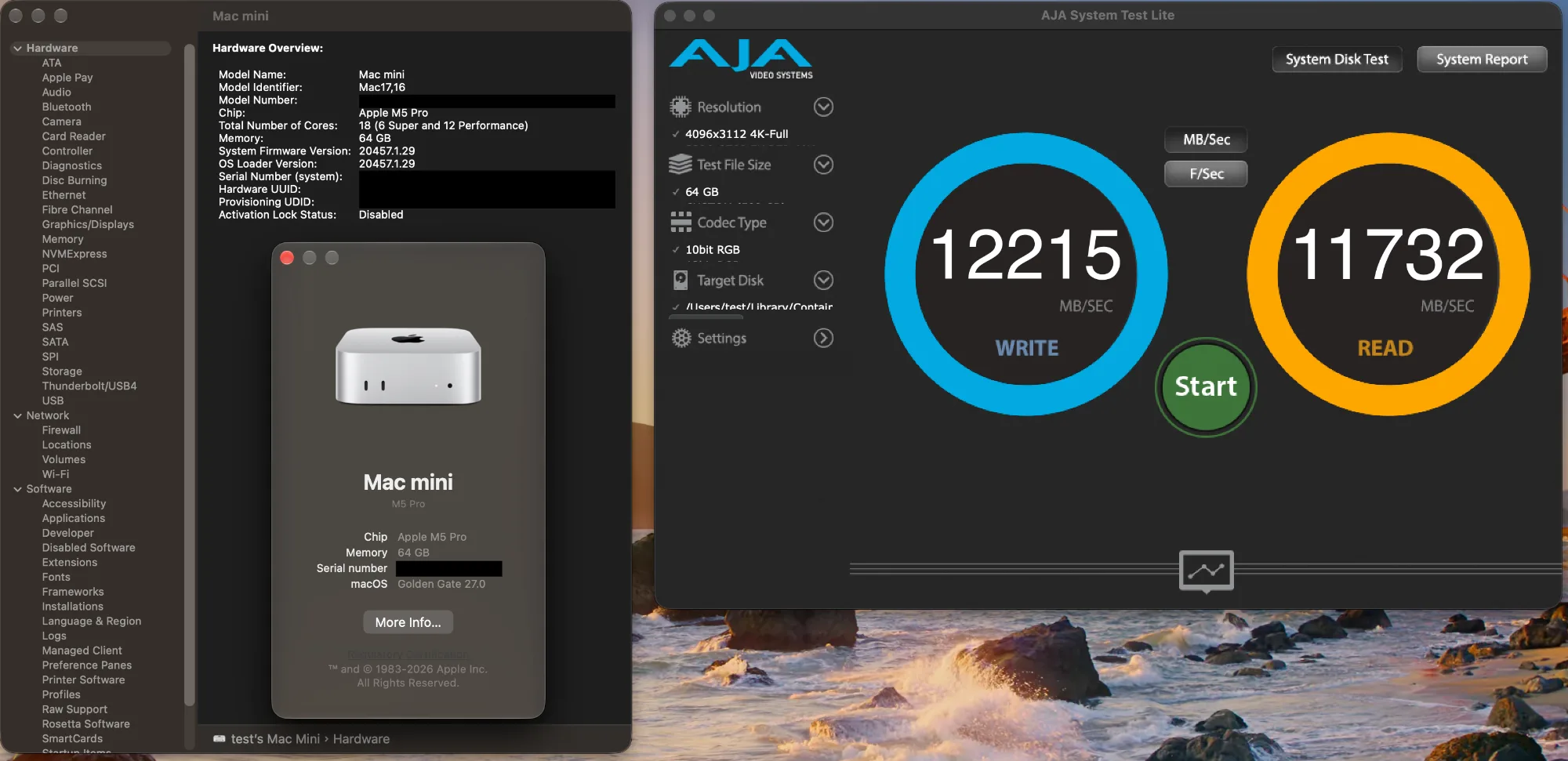
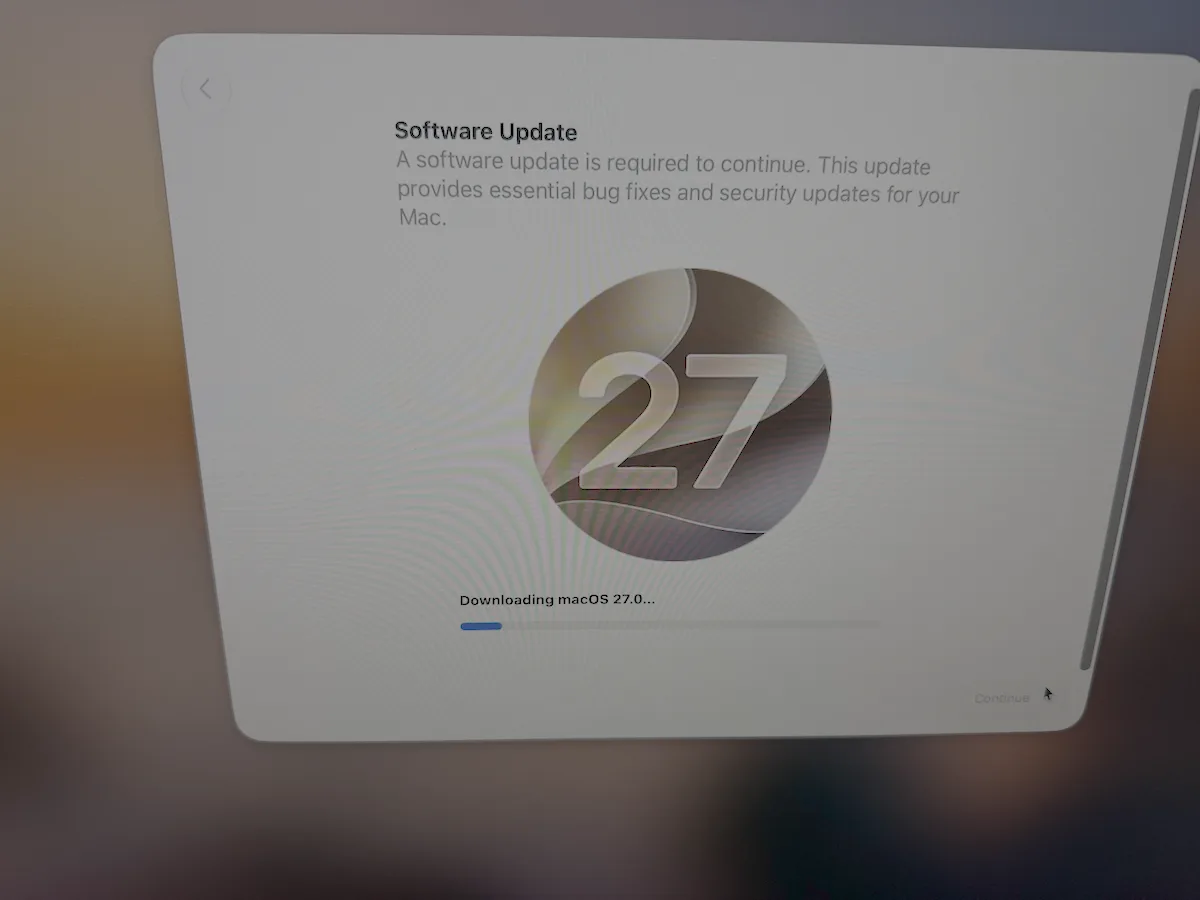
My unit is the M5 Pro Mac mini with an 18-core CPU, 20-core GPU, 64GB of unified memory and a 2TB SSD. Setup came with one small catch: the machine made me upgrade to macOS Golden Gate before I could get going. It was a bit of extra hassle, not a real problem, and everything worked fine once it finished.
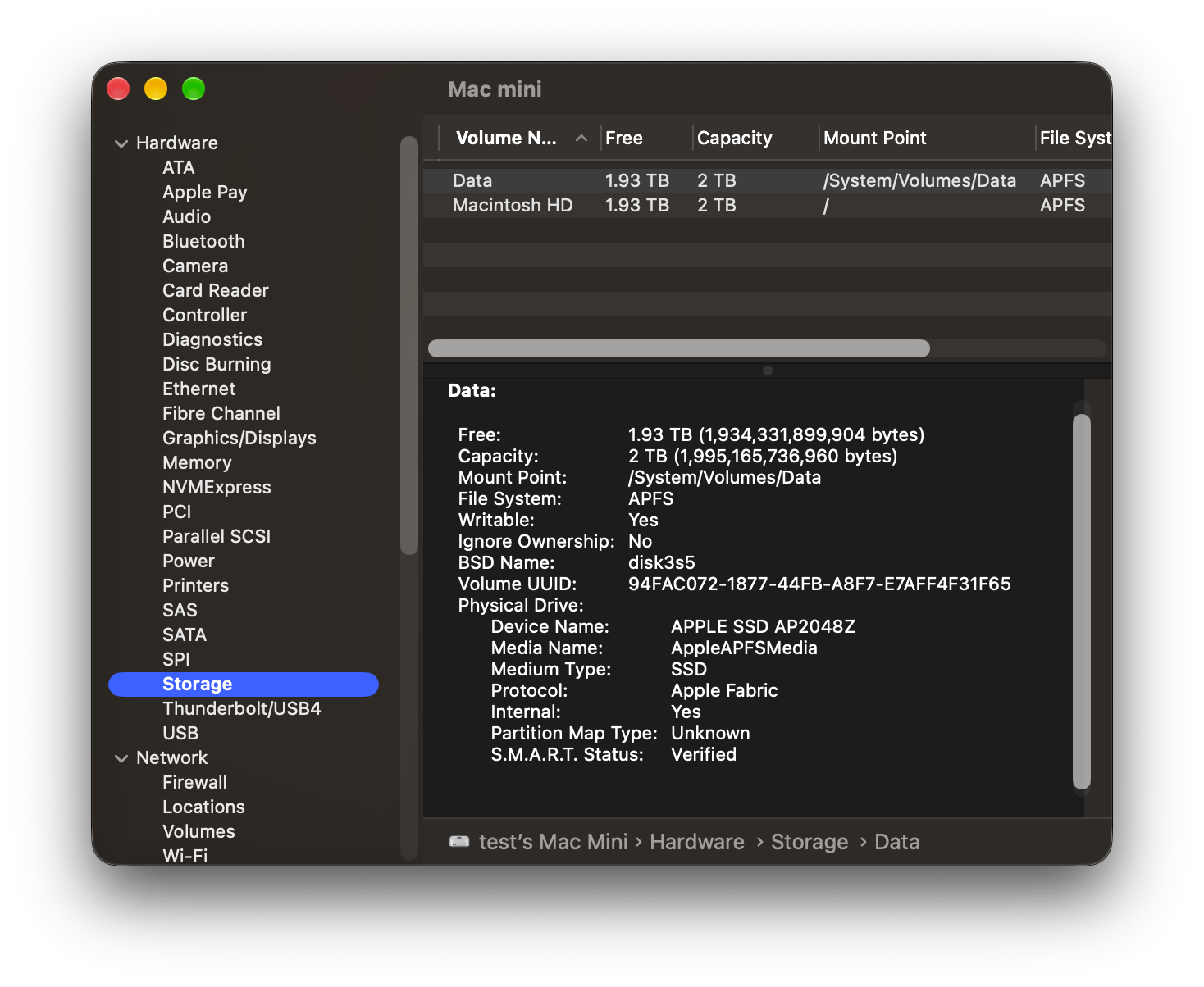
Specs
The M5 Pro model has the fastest memory in the new Mac mini lineup: 307GB/s of unified memory bandwidth, compared with 170GB/s on the M6 models. That is about 80% more bandwidth for the GPU, Neural Engine and big AI models.
Spec | M5 Pro Mac mini (tested unit) | M5 Pro options | M6 Mac mini |
|---|---|---|---|
CPU | 18-core | 15-core (5 super + 10 performance) or 18-core | 12-core (2 super, 4 performance, 6 efficiency) |
GPU | 20-core | 16-core or 20-core | 12-core |
Neural Engine | 16-core | 16-core | Dual 16-core |
Unified memory | 64GB | 24GB, 48GB or 64GB | 16GB, 24GB or 32GB |
Memory bandwidth | 307GB/s | 307GB/s | 170GB/s |
SSD | 2TB | 512GB to 8TB | 256GB to 2TB |
Rear ports | 3x Thunderbolt 5 (120Gb/s), HDMI, Ethernet | Same | 3x Thunderbolt 4, HDMI, Ethernet |
Front ports | 2x USB-C (USB 3), headphone jack | Same | Same |
Networking | Wi-Fi 7, Bluetooth 6, 2.5Gb Ethernet (10Gb option) | Same | Same |
External displays | Up to 3 | Up to 3 | Up to 3 |
Starting price (US) | — | $1,699 | $899 |
Specs from Apple's Mac mini tech specs and Apple Newsroom. The Mac mini announced in late August, 2026 and started shipping on September 22, 2026. Main reason I got M5 Pro, not M6, was because I want to run local AI clusters, and it's important to have Thunderbolt 5 connection. I will write another full review on this in later day.
How I tested
I used AJA System Test, a disk benchmark built for video work, which writes and reads large sequential video frames. I ran it on the internal 2TB SSD twice: a normal pass for peak speed, then a continuous run of more than 15 minutes. The long run matters most, because many SSDs slow down sharply once their fast cache fills up.
Results
The SSD did not slow down under a long load. After 15+ minutes, write speed was within 1% of the first run, and read speed was actually about 11% higher.
Test (AJA System Test) | Read (MB/s) | Write (MB/s) |
|---|---|---|
Standard run | 11,215 | 11,732 |
Sustained, 15+ minutes | 12,428 | 11,620 |
Change | +10.8% | −1.0% |
For context, 11 to 12 GB/s is close to double what today's fastest Thunderbolt 5 external SSDs reach (roughly 5.4 to 6.2 GB/s, approximate).
Why it holds up
I believe the steady numbers come from Apple's own SSD design. Apple builds the storage controller into the chip itself, so the Mac mini's SSD is raw flash managed by Apple silicon rather than a standard off-the-shelf drive. Apple does not publish its cache details, so this part is my reading of the results rather than a confirmed spec.
Integrated controller. The controller shares the chip with the CPU and unified memory, which keeps latency low and lets Apple tune it closely for macOS.
Large SLC cache. Most SSDs write first to a fast SLC cache, then slow down once it fills. On a 2TB drive with lots of free space, that cache can be very large, which would explain why write speed barely moved over 15 minutes.
Headroom from capacity. Bigger Apple SSDs use more flash chips in parallel, so the 2TB model should be faster than the 512GB base model.
Verdict
The M5 Pro Mac mini's internal SSD is very impressive: about 11 to 12 GB/s both ways, with no slowdown after 15+ minutes of sustained load. For 4K and 8K video editing, big photo libraries or large AI model files, the internal drive will rarely be the bottleneck. Pair it with 307GB/s of memory bandwidth and Thunderbolt 5, and this small desktop feels like a real pro machine. The forced move to macOS Golden Gate was a minor bump on day one, not a reason to hold back.