The short version
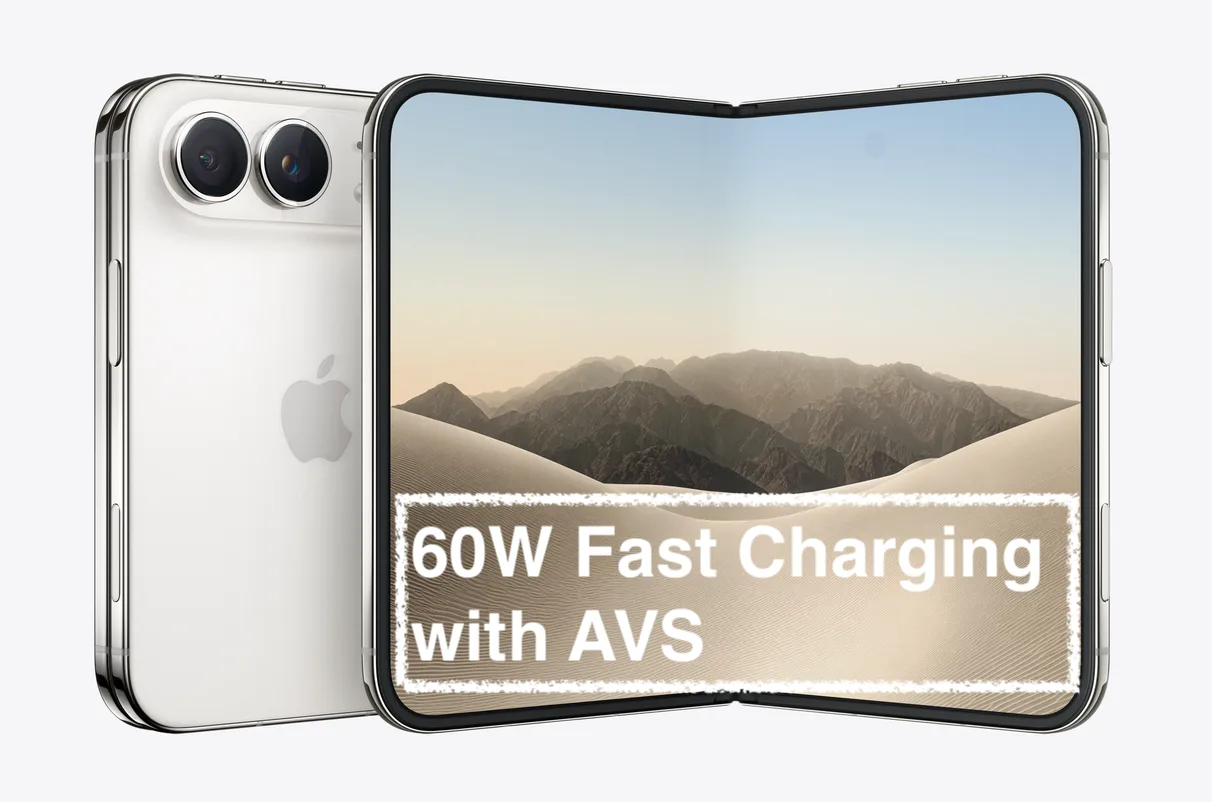
The iPhone 18 Pro Max and iPhone Duo only fast charge past 45W when the charger supports USB PD AVS (Adjustable Voltage Supply). On a regular USB PD charger with fixed voltages, our 2TB unit topped out at 45W. With Apple's 40W Dynamic Power Adapter, which supports AVS, the Ellisys Type-C Tracker captured an 18V / 3A power contract: 54W on the wire.
A "65W" label on the box is not enough. An Anker Nano charger rated for 65W, bought on Amazon, never reached the AVS fast-charge mode on these phones based on our tests. Below we explain what AVS is, why it keeps the phone cooler, and what the protocol logs show.
What AVS is
AVS lets the phone ask the charger for almost any voltage between 9V and 20V, in 100mV steps. It is part of the USB Power Delivery 3.2 specification, released in October 2023, which extended AVS from the high-power EPR range down to the standard power range (SPR) that phone chargers use (GRL).
There are three ways a USB-C charger can offer power:
Mode | Voltage the phone can request | Step size | Notes |
|---|---|---|---|
Fixed PDO | 5V, 9V, 15V, 20V only | n/a | Every PD charger has these. iPhone 18 Pro Max uses 15V here, which caps at 45W (15V × 3A). |
PPS | 3.3V–21V | 20mV, 50mA | Built for direct charging on Android phones. The source enforces a current limit. |
SPR AVS | 9V–15V (chargers up to 45W); 9V–20V (above 45W) | 100mV | What the iPhone 18 Pro Max needs to go above 45W. |
The 9V–20V range matters. A charger rated 45W or less only has to offer AVS up to 15V, so it can never deliver the 18V the iPhone 18 Pro Max and iPhone Duo ask for. You need an AVS charger rated above 45W, and in practice about 60W (ifanr).
Why AVS matters: more watts, less heat
AVS lets Apple push more power into the phone without pushing more heat into it. Heat during fast charging comes mostly from two places: resistive loss in the cable and connector (it grows with current squared), and conversion loss inside the phone as it steps the input down to battery voltage.
Higher voltage, same current. A standard USB-C cable carries 3A. At the fixed 15V step that means 45W at most. AVS lets the phone pick 18V and get 54W through the same 3A, with no 5A cable and no extra current through the connector.
The voltage the phone wants, not the nearest fixed step. Fixed PD only offers 15V or 20V. With AVS the phone chooses the input voltage its charging circuit converts most efficiently, so less of the 54W becomes heat. Apple hasn't published the internal design; this is the general reason sink devices prefer a programmable source.
Measured result. In ifanr's test, the iPhone 18 Pro's case peaked at 38.7°C over the first 30 minutes on AVS. They credit both the 18V conversion path and a vapor chamber about three times larger than before (ifanr).
One point of wording: the "60W" Apple quotes is the charger's power class. The iPhone 18 Pro Max itself peaks at about 54W (18V × 3A), and only for roughly the first 10 minutes before current tapers.
Test setup: Ellisys Type-C Tracker
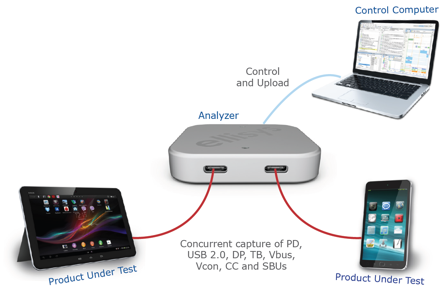
We captured every charging session with the Ellisys Type-C Tracker, a protocol analyzer that sits inline between charger and phone. A USB-C power meter shows volts and amps; the Tracker shows why the phone and charger settled on them.
What we need to see | Typical USB-C power meter | Ellisys Type-C Tracker |
|---|---|---|
Live voltage and current | Yes | Yes, as Vbus state in a time-synchronized view |
Source_Capabilities (every PDO and APDO the charger offers, in order) | Partial or none | Fully decoded, down to field and bit |
Request / Accept / PS_RDY sequence and timing | No | Yes, with precise timing between any events |
CC, Vconn and SBU line states | No | Yes |
DisplayPort, Thunderbolt 3 / USB4 sideband, Alt Mode traffic | No | Yes |
Sharing logs with other engineers | Screenshots | Saved captures, free viewer, cloud sharing |
The Tracker costs far more than a consumer PD meter. For this test that cost is justified: whether a charger "supports AVS" is answered by its Source_Capabilities message, not by a wattage reading.
Test 1: Apple 40W Dynamic Power Adapter — AVS works
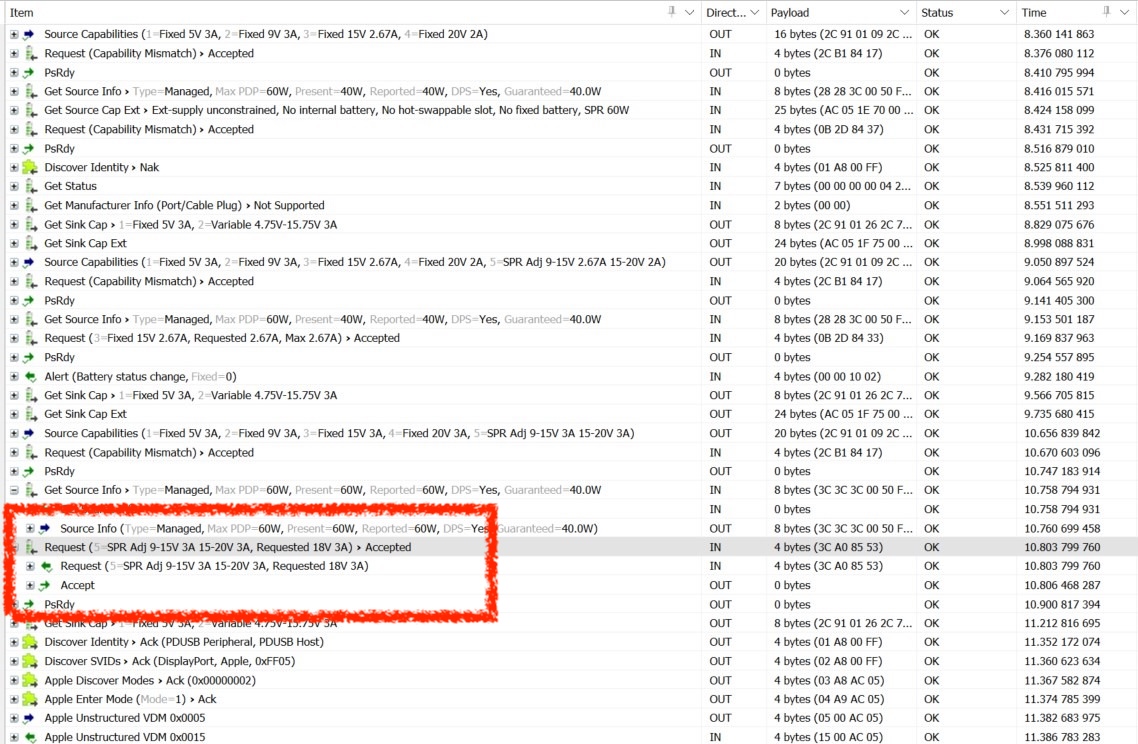
With Apple's 40W Dynamic Power Adapter (60W Max), the iPhone 18 Pro Max negotiated an AVS contract at 18V / 3A, or 54W. This is the full fast-charge mode, and it was the only charger in our test that reached it.
What the Ellisys capture shows:
Source_Capabilities from the adapter lists its fixed PDOs plus an SPR AVS APDO covering up to 20V.
Request from the iPhone Duo selects the AVS APDO at 18.0V, 3A.
Accept, then PS_RDY once Vbus settles at 18V.
Test 2: Anker Nano Charger Neo — no AVS fast charge
Our Anker Nano Charger Neo, bought on Amazon, never put the iPhone 18 Pro Max and Duo into its 18V AVS mode. The phone stayed on the slower fixed-PDO path.
That result is surprising, because Anker sells this charger as a 45W unit with "up to 65W dynamic output", hopefully they can fix it by updating PD firmware or hardware.
iPhone Duo: same charger, same rules
The iPhone Duo, Apple's foldable, on sale since October 2026, uses the same AVS fast-charging path. Apple's 40W Dynamic Power Adapter unlocks it.
iPhone 18 Pro Max | iPhone Duo | |
|---|---|---|
Fast charge needs | SPR AVS, 60W class | SPR AVS, 60W class |
Apple 40W Dynamic Power Adapter | Yes | Yes |
Apple's 0–50% claim | About 15 minutes | About 20 minutes |
MagSafe 0–50% | Not covered in this test | About 30 minutes (35W+ adapter) |
Verdict
To fast charge the iPhone 18 Pro Max or iPhone Duo, buy a charger that offers SPR AVS up to 20V with at least a 60W power class. Today the Apple 40W Dynamic Power Adapter is the one we have verified on the analyzer.
We also highly suggest to use a good quality of USB-C cable or Thunderbolt cable. Don't use the cheap one!
Buy from Amazon
Apple 40W Dynamic Power Adapter with 60W Max
Anker Nano Charger Neo
CalDigit Thunderbolt 5 Pro Cable
CalDigit Thunderbolt 4 Pro Cable (White)
OWC Thunderbolt 5 Cable (0.3m)
Note: ReviewTonight is an affiliate partner with Amazon. When you click a link and make a purchase, we may receive a small payment, which helps us keep the site running.